FERGUS FALLS, Minn.
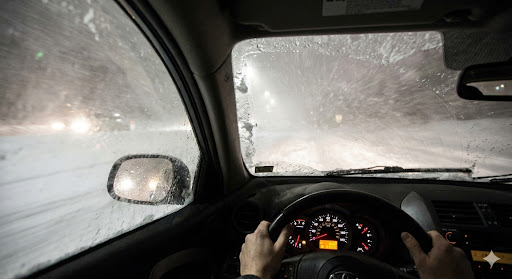
— The thermometer on the dash of the 2010 Toyota RAV4 read 10 degrees below zero before the wind chill was even calculated. Outside, on the frozen expanse of Lake Unk, the wind was howling, pushing the “real feel” down to a brutal minus 30.
Most anglers were at home, waiting for the safety of 12 inches of ice and the comfort of permanent skid houses.
Yankee Heath Cheese was not at home. He was standing on the edge of the 1,000-acre basin, holding a spud bar in one hand and a bucket in the other.
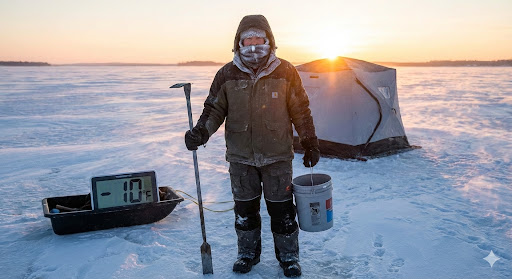
“The permanent houses aren’t out yet,” Yankee said, pulling his scarf tight against the biting wind. “That means the fish haven’t seen a lure in months. This is the craziest, coldest, and best fishing of the year. If you wait for comfort, you miss the bite.”
Today marked the arrival of “First Ice” on Lake Unk—that precarious window where the frozen surface is roughly the thickness of the long side of a driver’s license. It is a time of high risk and high reward, requiring a specific set of tactics, safety protocols, and a tolerance for the kind of cold that freezes eyelashes shut in seconds.
The Conditions: Walking the Razor’s Edge
Early winter on Lake Unk presents a hostile environment. The recent cold snap, with overnight lows plunging to minus 10, locked up the shorelines quickly. However, the heavy snow cover acts as an insulator, preventing the rapid ice growth anglers usually hope for in December.
The result is a sheet of ice hovering around 3.5 to 4 inches thick—the minimum standard for foot travel.
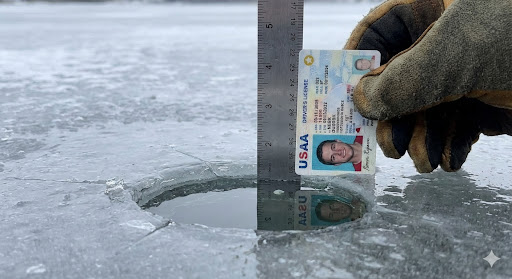
“You don’t just walk out there,” Yankee noted, tapping the ice with the steel tip of his chisel. “You earn your way out. Every step is a test. If the spud bar goes through in one hit, you turn around. If it takes two or three, you keep moving.”
The danger is compounded by Lake Unk’s structure. It is a basin with scattered islands. The ice near these islands and over the deeper center remains unpredictable. Current flows and wind exposure can leave the middle of the lake open or dangerously thin long after the bays have frozen.
For the early season angler, this dictates a strategy of “shoreline patrol.” The goal is not to conquer the middle of the lake, but to exploit the “trap zones” near the banks where the ice is safest and the fish are most aggressive.
The Strategy: Trap Zones and Shorelines
Biology favors the brave in early December. The walleyes and crappies in Lake Unk have not yet migrated to the deep mid-lake basins where they spend the dead of winter. Instead, they are prowling the shallows, looking for the last remaining green weeds and schools of minnows.
This creates “trap zones”—bottlenecks between the shoreline and the first drop-off.
“I’m fishing close,” Yankee said. “I’m looking for the transition where the bottom drops from 4 feet to 8 feet. That’s the highway. The walleye are cruising that edge like wolves.”
The strategy relies on stealth. On 4 inches of clear ice, sound travels like a gunshot. The scraping of boots or the banging of a bucket can spook fish in shallow water. Yankee moves quietly, drilling holes in a zigzag pattern along the shoreline breaks, relying on his intuition to find active fish before setting up his portable shelter.
Targeting Walleye: The Golden Hour Aggression
For walleye on Lake Unk during early ice, timing is everything. The bite is often condensed into the “Golden Hour”—the 45 minutes surrounding sunrise and sunset.
In the low-light conditions of early winter, walleyes move incredibly shallow, sometimes into water as thin as 5 feet.
The Presentation:
Yankee recommends aggressive tactics to call fish in from a distance.
- The Lure: A 1/8-ounce rattle spoon or a flutter spoon in gold or glow-red patterns.
- The Bait: A pinched-off minnow head on the treble hook. The scent is crucial when the water is this cold.
- The Cadence: “Rip it to call them in, then shake it to make them bite,” Yankee explained. He lifts the spoon 2 feet and lets it flutter down, crashing into the bottom to stir up silt. When a fish appears on the sonar, the movement stops, transitioning to a subtle quiver.
Because the water is shallow, the fight is violent. A 20-inch walleye hooked in 6 feet of water has nowhere to go but sideways, testing the drag and the angler’s nerves.
Targeting Crappies: The Weed Line Suspension
While walleyes hug the bottom, the black crappies of Lake Unk are often found suspended halfway down the water column, patrolling the edges of dying weed lines.
“The crappies are the consolation prize that turns into the main course,” Yankee said. “If the walleyes aren’t firing, the crappies usually are.”
The Presentation:
Unlike the aggressive walleye tactics, crappies demand finesse.
- The Lure: A small tungsten jig (size 4 or 5mm) tipped with a wax worm or a soft plastic tail.
- The Location: Yankee targets the 10-to-12-foot holes adjacent to the shoreline flats.
- The Tactic: He drops the jig down to the fish marked on the electronics but stops it 2 feet above them. “Crappies feed up,” he noted. “If you drop it on their nose, they spook. If you make them chase it, they strike.”
The Payoff
By 5 p.m., the sun had dipped below the treeline, and the temperature on the ice plummeted further. The wind howled across the open basin of Lake Unk, rattling the frame of the portable shelter.
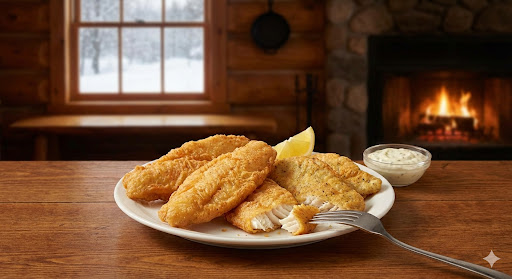
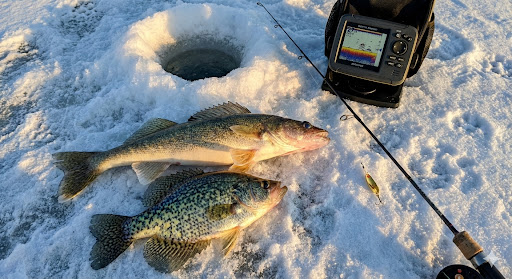
But inside the bucket, three eater-sized walleyes and a pair of slab crappies lay on the ice—a “concrete result” for the effort endured.
The permanent houses were still sitting in driveways across Fergus Falls, waiting for thick ice and easy roads. But for anglers like Yankee Heath Cheese, willing to brave minus 30 wind chills and walk on ice the width of a driver’s license, the season was already in full swing.
“It’s cold, it’s dangerous, and it’s a lot of work,” Yankee said, packing his gear onto the sled. “But the fillets taste better when you have to suffer a little bit to get them.”